UPGRADE – Urban Pathogen Genomic Surveillance Network
A dynamic Romanian-Moldovan research collaboration for rapid pathogen identification and real-time genomic surveillance in complex urban environments. Monitoring antimicrobial resistance genes and pathogens in university campuses through Oxford Nanopore sequencing and advanced bioinformatics, strengthening regional public health surveillance.
From on-site sampling to interactive dashboards in a single modular framework.
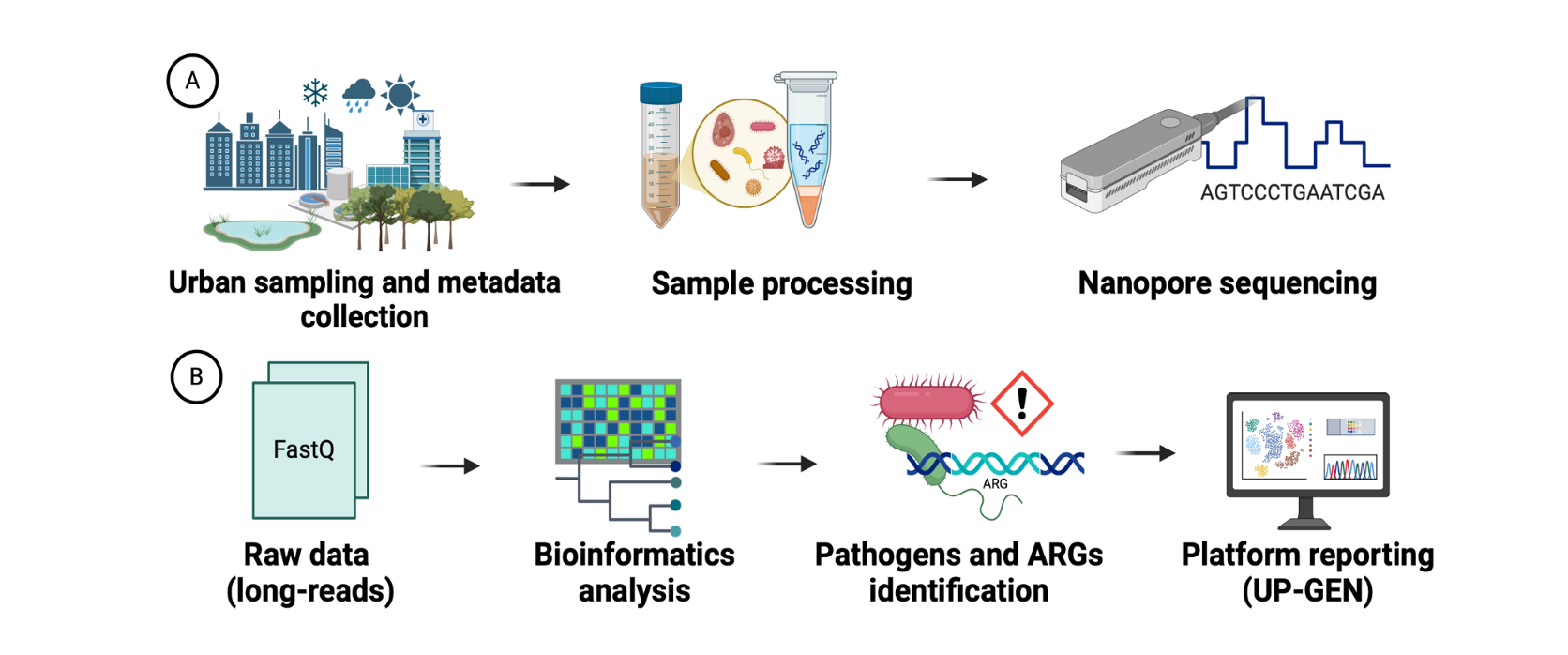
Project Overview
UPGRADE addresses the urgent global challenge of antimicrobial resistance (AMR), with projections estimating over 39 million deaths by 2050. This Romanian-Moldovan collaboration establishes comprehensive genomic surveillance in university campuses—dynamic, densely populated environments where human, animal, and environmental factors converge. University campuses with over 10,000 daily interactions serve as representative urban microcosms for studying pathogen transmission and ARG circulation.
Campus surveillance
Over 100 environmental samples collected from high-traffic university locations: restaurants, cafes, study rooms, laboratories, and outdoor spaces. Comprehensive metadata including seasonal variations, temperature, humidity, and demographic data.
Nanopore sequencing
Oxford Nanopore GridION platform with R9.4.1 flow cells for 72-hour deep sequencing. Optimized DNA extraction protocols using Quick-DNA HMW MagBead Kit and automated library preparation for complex environmental metagenomics.
Romanian-Moldovan collaboration
Romania leads sample generation and sequencing infrastructure. Moldova specializes in bioinformatics framework development and data analysis. Joint dissemination through publications, conferences, and the UP-GEN platform.
UPGRADE Workflow
A comprehensive 24-month project structured into 5 work packages: from systematic campus sampling and metadata collection through Oxford Nanopore sequencing, to modular bioinformatics analysis and community platform deployment. Weekly samples collected across four seasons from university restaurants, cafes, laboratories, and public spaces.
- Weekly triplicate sampling from 4 location types per ISO 5667-10:2020
- Environmental metadata: temperature, humidity, seasonality, demographics
- DNA extraction with Quick-DNA HMW MagBead Kit and AMPure XP cleanup
- Quality verification: Nanodrop 2000, Qubit 4, Tapestation 4200
- Library prep with ONT SQK-LSK109 kit for GridION sequencing
- Quality control with NanoPlot and Filtlong
- Assembly with Flye, polishing with Racon and Medaka
- ARG annotation using Abricate against CARD database
- Taxonomic classification with Sourmash and Kraken2
- Functional profiling with Prokka and Bayesian modeling
- UP-GEN platform deployment with interactive visualization
Work Packages & Components
Five integrated work packages spanning project coordination, sample collection, bioinformatics framework development, platform deployment, and knowledge dissemination.
WP1: Project Management
24-month coordination led by USV with TUM participation. Monthly meetings, risk management, resource allocation, and progress monitoring ensuring seamless Romanian-Moldovan collaboration.
WP2: Sample Collection
100+ environmental samples from Suceava University campus. Systematic weekly collection, comprehensive metadata, streamlined DNA extraction and GridION sequencing protocols.
WP3: Bioinformatics Framework
Modular analysis pipeline for long-read metagenomics. Tool benchmarking (Flye, Kraken2, MetaPhlAn, DeepARG), functional profiling, environmental metadata integration, and automated reporting.
WP4: UP-GEN Platform
Community-oriented cloud platform for pathogen surveillance. Interactive GUI with geospatial visualization, temporal analysis, microbial profiling tools, and curated urban surveillance datasets.
WP5: Dissemination
Scientific publications in Q1/Q2 journals, presentations at RoBioinfo, ECCO2026, ESCMID conferences. Exploration of Horizon Europe and JPIAMR funding opportunities.
Research Infrastructure
USV: Molecular Biology Lab, GridION/MinION sequencers, Ion GeneStudio 5, Cloud & Big Data Center. TUM: CIRCLE high-performance computing. Both registered on EERTIS platform.
Research Team
A complementary Romanian-Moldovan collaboration bringing together expertise in microbiology, molecular biology, bioinformatics, and software engineering.
- Roxana Filip (Project Director, USV) – Professor HABIL, expert in bacterial resistance mechanisms
- Inna Rastimesina (Co-Director, TUM) – Environmental microbiology and biotransformation
- Mihai Dimian (Senior Researcher, USV) – 160+ publications, Rector of USV
- Liliana Anchidin-Norocel – Metagenomics expertise
- Dumitru Ciorbă – Computational biology and bioinformatics
- Viorel Munteanu – Bioinformatics research
- Eugeniu Catlabuga – Software engineering & platform development
Key Innovations
- Methodological advances in metagenomics for environmental surveillance
- Integrated protocol from planning to taxonomic analysis
- Novel datasets from Romanian and Moldovan campuses
- Geospatial and temporal aggregation across 100+ samples
- One Health approach linking human, animal, and environmental health
- Technology transfer through training and collaboration
Project Timeline & Deliverables
24-month project with structured milestones and deliverables across five work packages. Building on previous RoGenoFil and MetBio-WGSP experience for accelerated implementation.
Cognitive and Socio-Economic Impact
Scientific, cognitive and socio-economic contributions generated through environmental genomic surveillance and advanced bioinformatics.
The activities carried out generate a direct scientific impact through the development of a complete and reproducible methodological framework for environmental genomic surveillance. This includes the standardization of sampling and processing protocols, the generation of a coherent set of urban samples with associated metadata, and the implementation of an integrated bioinformatics workflow for their analysis.
The integration of these components within the UP-GEN platform enables a scalable analytical infrastructure that ensures parameter traceability, supports the integration of geospatial data, and allows robust detection of microbial taxonomy and antimicrobial resistance determinants.
From a cognitive perspective, the work advances the understanding of urban microbiome dynamics and the mechanisms underlying the spread of antimicrobial resistance.
From a socio-economic perspective, it provides a scientific basis for evidence-based public health policies, supports urban health monitoring, and contributes to the management and mitigation of biological risks in complex environments.
Dissemination of Results
Conferences
Smart Diaspora 2025 (Romanian Scientific Diaspora Conference), held on November 4–7, 2025, in Cluj-Napoca, Romania, where the presentation entitled “Building Bioinformatics Capacity in Moldova” was delivered in the session “Perspectives in AI-Driven Computational Biology.”
https://diaspora-stiintifica.ro/
Publications
Munteanu, V., Saldana, M.A., Dreifuss, D. et al. SARS-CoV-2 wastewater genomic surveillance: approaches, challenges, and opportunities. Genome Biol 27, 1 (2026).
https://doi.org/10.1186/s13059-025-03927-6